
You have just received your prescription from your ophthalmologist and some of the numbers are confusing you?
Don't panic. We'll help you decipher the essential information so you can better understand your prescription and your visual needs.
The powers of corrective lenses
First of all, it is important to know thatyour right eye and your left eye do not necessarily need the same correction, and therefore your prescription distinguishes between "OD" for your right eye and "OG" for your left eye.
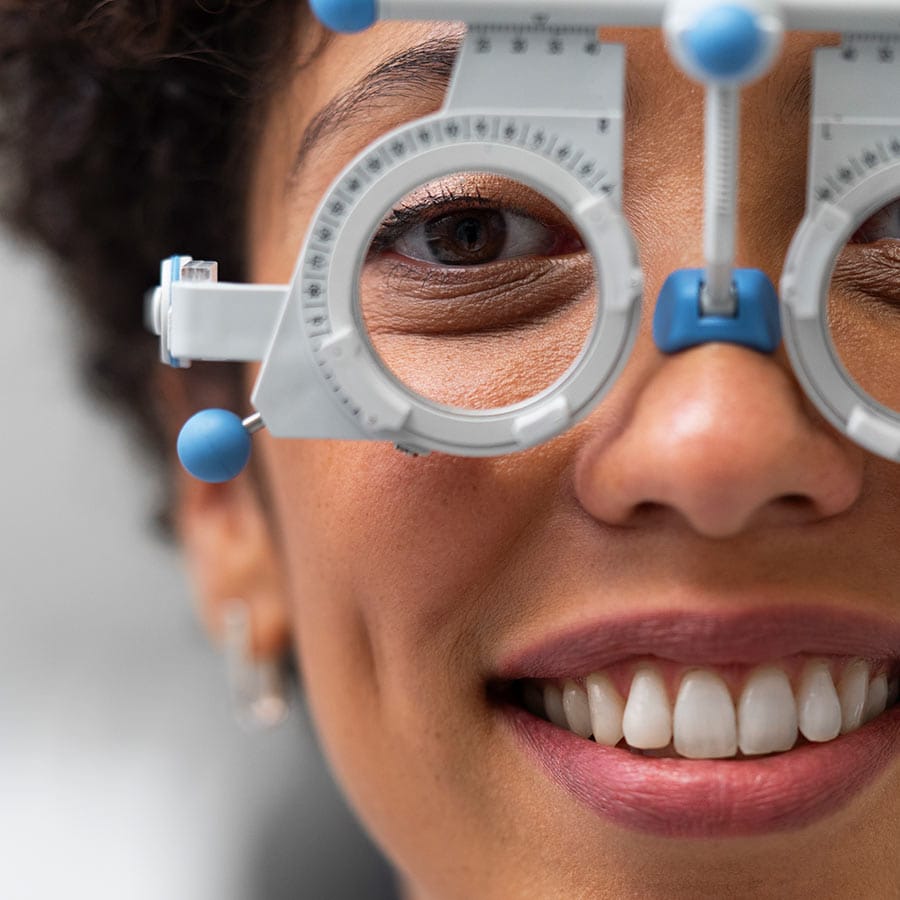
Behind this abbreviation appears the spherical power expressed indiopters, preceded bythe + or– sign.
Thesign – indicates a correction fornearsightedness. This means that your eye needs aconcave lens, which helps you see distant objects better.
Example: OD -1.00
The+ sign indicates a correction for presbyopia or hyperopia. In this case, aconvex lens is needed to facilitate near vision.
Example: OD +1.00
If this indication is followed by asecond number, often writtenin parentheses, it means that you needtoric lenses. This number corresponds to the cylinder power used to correct astigmatism.
Athird number ranging from 0° to 180° indicatesthe axis of the cylinder, i.e., the orientation of the correction.
Example: OD -1.00 (-0.75) 45°
These numbers representthe strength of the corrective lenses. They do not directly indicate your visual acuity and, unless otherwise specified by the prescriber, indicate the correction required fordistance vision.
Finally, an additional indication may appear on your prescription to specify yournear vision needs: this is known asthe addition.
The addition corresponds to thedifference in power between distance vision and near vision, particularly in cases of presbyopia.

Prescription strengths for eyeglasses and contact lenses
It is also important to note that these values correspond only to the strength of eyeglass lenses. The correction required for contact lenses may be different, even for the same visual impairment.
That is why it is up to the optician to determine the exact power of the contact lenses, taking into account several parameters specific to their wear.
Need help understanding your prescription?
Our opticians are available to explain your prescription and advise you on the best lenses for your vision.
Recent Comments